The profession behind padel growth
Padel’s growth is increasingly measurable. We know where courts are being built, which markets are expanding and how much economic activity the sport generates. What remains less understood is how that expansion translates into sustainable professional opportunities for coaches.
The FIP World Padel Report 2026 provides an important starting point. Its first coaching licence survey identified almost 11,000 licences from responses covering just over half its affiliated federations. The figure offers an initial view of the coaching landscape, but it is not a count of unique employed coaches or available positions.
1. Court expansion is a starting point, not an employment forecast
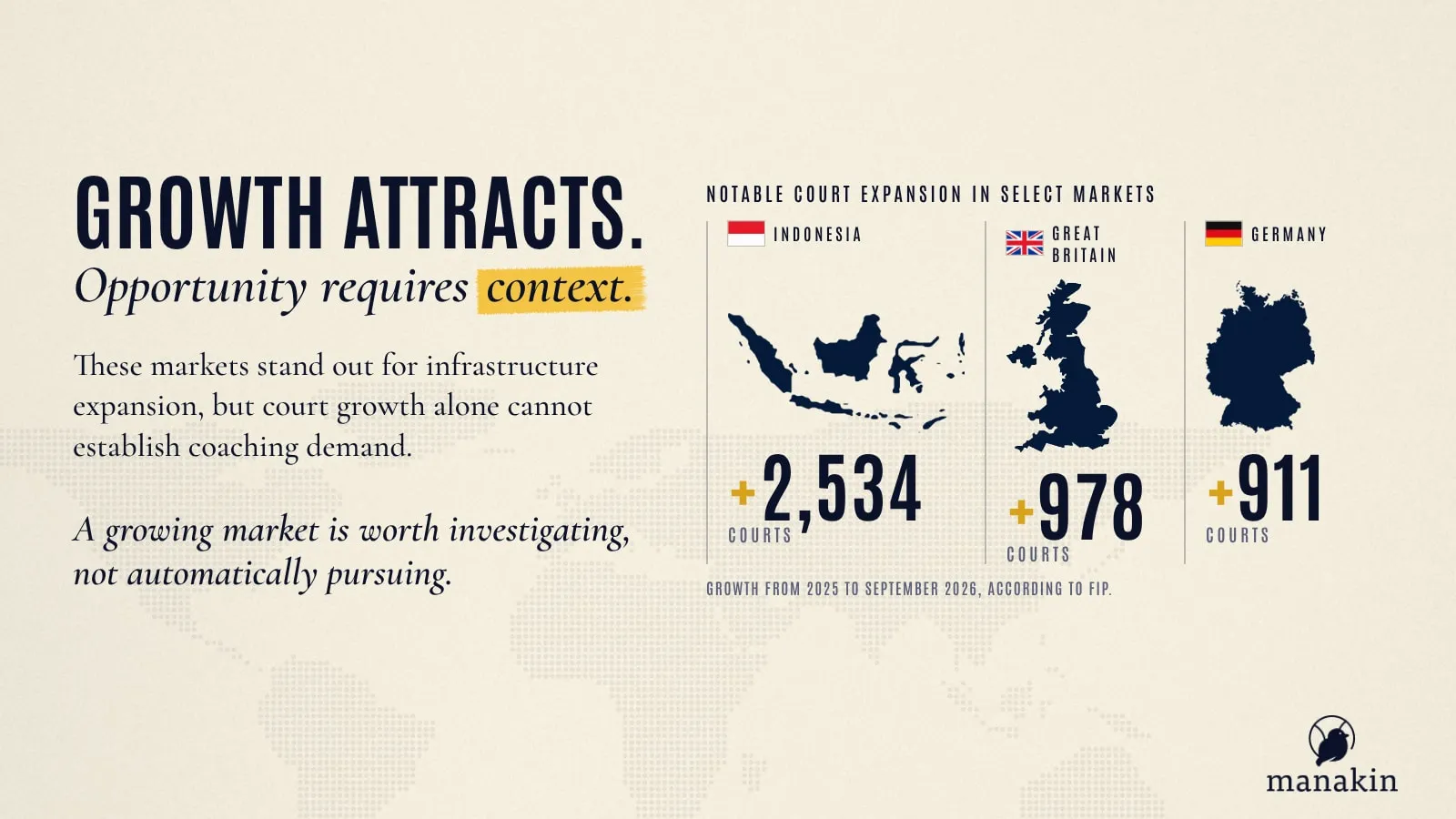
Padel court growth from 2025 to September 2026: Indonesia added 2,534 courts, Great Britain 978 and Germany 911, according to FIP.
Between the 2025 reporting period and September 2026, Indonesia added 2,534 courts, Great Britain 978 and Germany 911, according to the report. These figures identify markets worth investigating, but they cannot independently establish the number, quality or sustainability of coaching positions.
Sweden offers a useful historical caution. After rapid padel infrastructure expansion, the country experienced significant facility closures; Sveriges Radio reported that around 70 padel halls had closed in 2022. This documents a risk of oversupply, not a measured decline in coaching employment. For a coach weighing an international move, court numbers should be considered alongside player demand, club occupancy and employment terms.
2. Coaching education as a specialisation
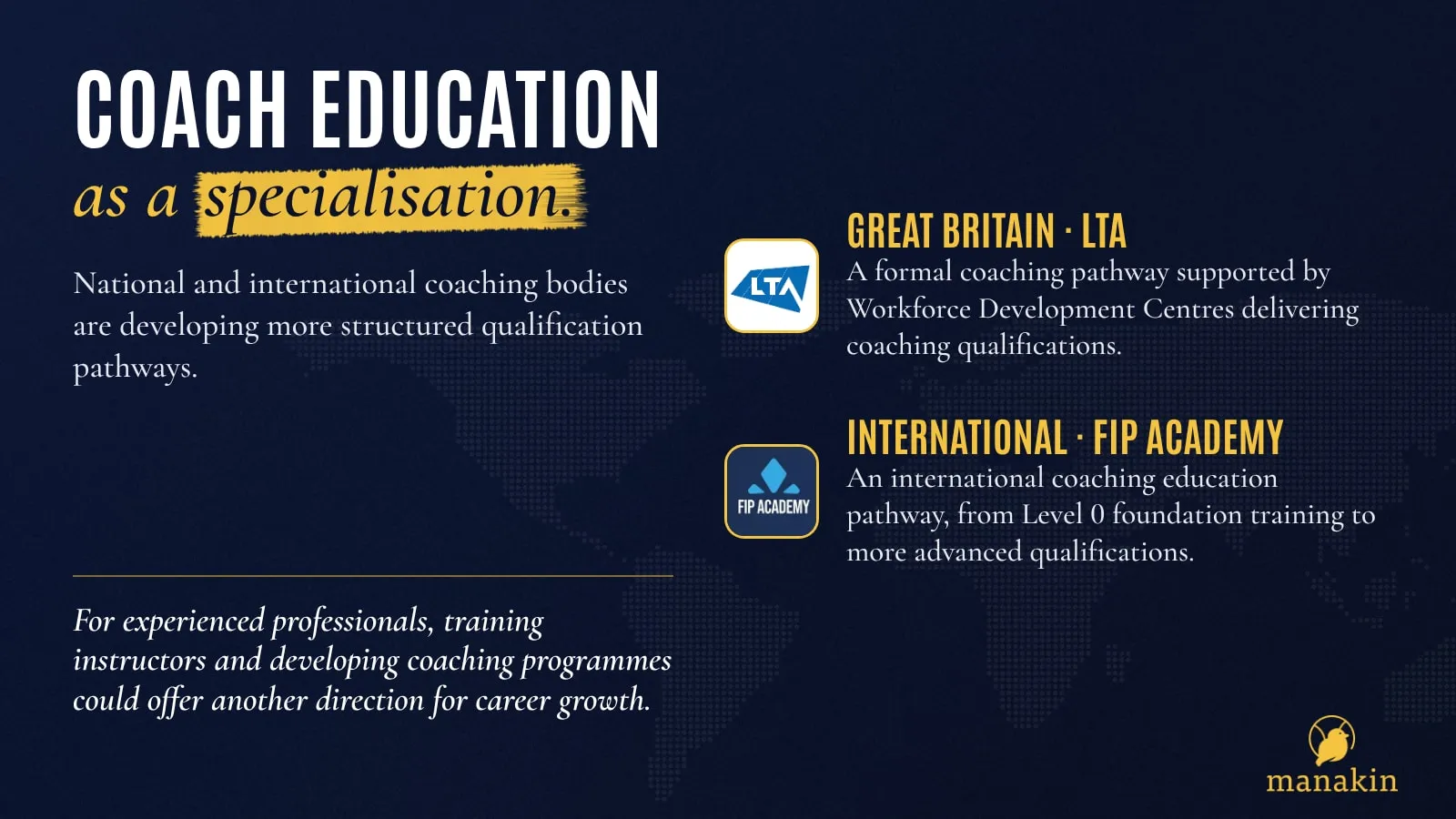
Padel coaching qualification pathways through the LTA in Great Britain and FIP Academy, highlighting opportunities for professional development.
National and international bodies are developing more structured coaching pathways. In Great Britain, the LTA operates a coaching qualification system supported by Workforce Development Centres; its broader coaching provision should not be mistaken for padel-only training. Internationally, FIP Academy launched Level 0 foundation training in 2026 and outlined more advanced levels for future development.
For experienced coaches, these developments raise a practical career question: could programme design and coach education become additional areas of specialisation? The pathways exist or are being developed, but their existence alone does not establish how many paid educator roles are available.
3. Language as career capital
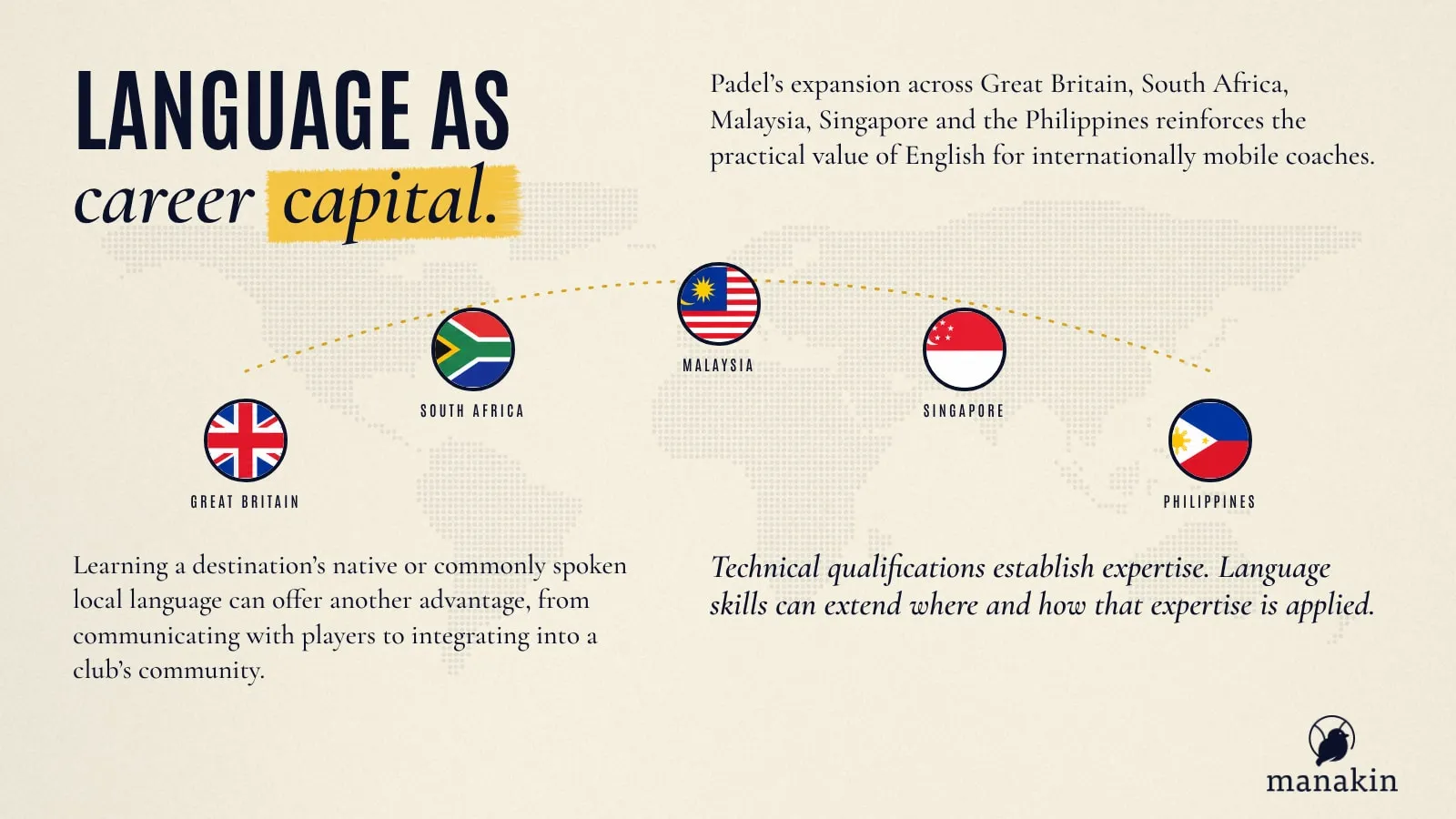
English language skills and international padel coaching opportunities across Great Britain, South Africa, Malaysia, Singapore and the Philippines.
Language proficiency is not merely a theoretical advantage. Vacancies published on Manakin show that employers already specify communication requirements alongside coaching credentials and experience. The precise combination varies by market and position.
For example: Prestige Padel in Casablanca sought French and Spanish speakers, Echevarri Sports in Marbella required English and Spanish, while Smash Padel in Jakarta prioritised English fluency. Requirements vary considerably by market and clientele.
These listings show that language proficiency can determine eligibility or strengthen suitability for specific roles; they do not prove that multilingual coaches are hired more frequently or paid more. Coaches considering international mobility can use actual job criteria to decide which language skills merit investment.
4. Understanding local certification pathways
Indonesia illustrates why market research should extend beyond court construction. Alongside the reported increase of 2,534 courts, the national federation PBPI announced a coaching certification programme in 2026, developed with FIP support and beginning with FIP Academy Level 0.
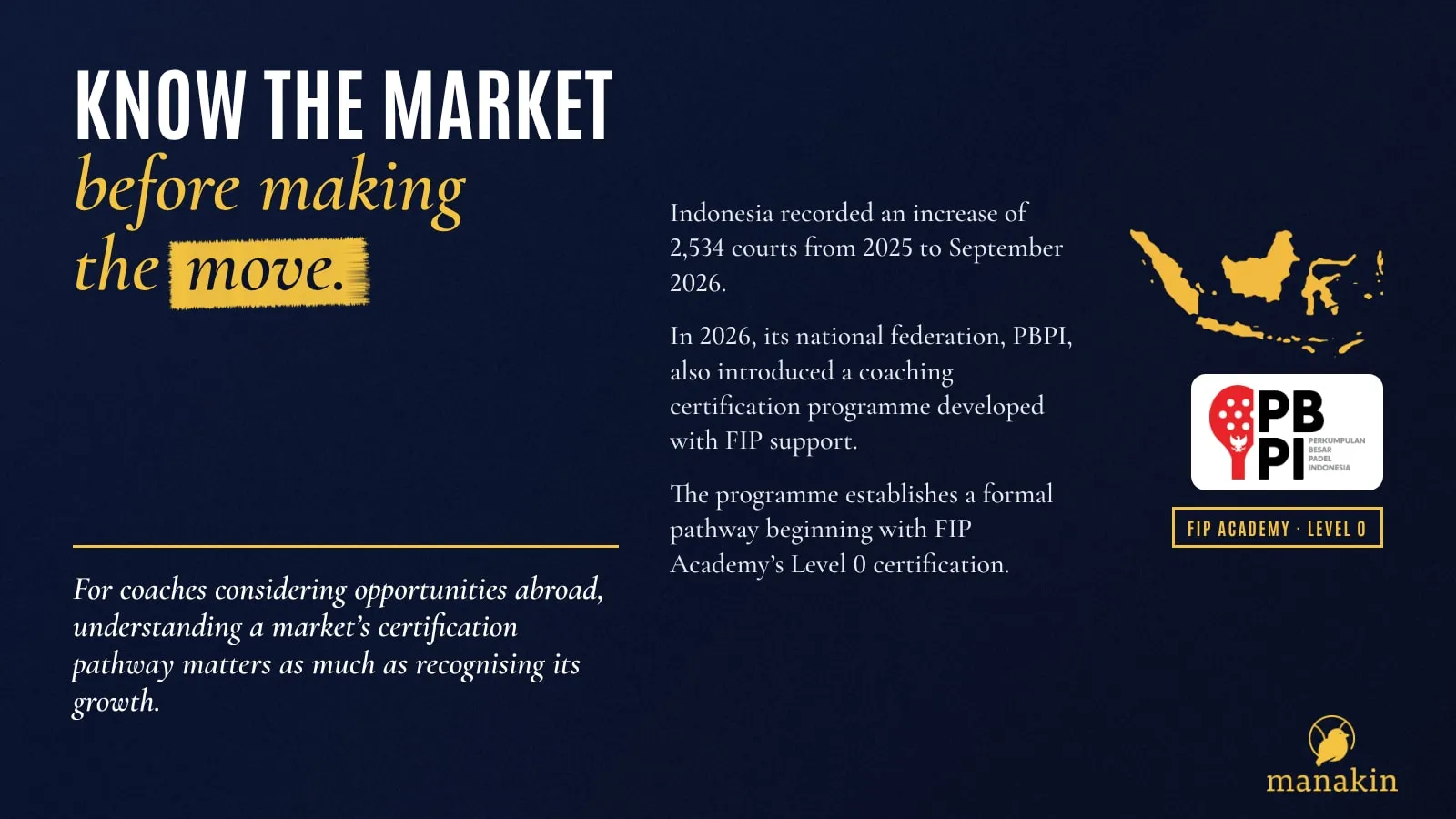
Indonesia’s padel expansion and new PBPI coaching certification programme, highlighting the importance of researching qualifications before working abroad.
The programme demonstrates a developing qualification pathway; it does not establish that Level 0 is a legal requirement for every coach in Indonesia. Coaches exploring a move should distinguish between federation certification, employer preferences, recognition of existing qualifications and any applicable work requirements.
5. The gap in padel’s economic research
FIP and OpenEconomics estimate approximately €6.84 billion in annual global padel spending across the categories included in their study, such as court rental, facility construction and maintenance, equipment and tournaments. This expenditure figure is distinct from the report’s estimates of GDP contribution, economic output and jobs supported.
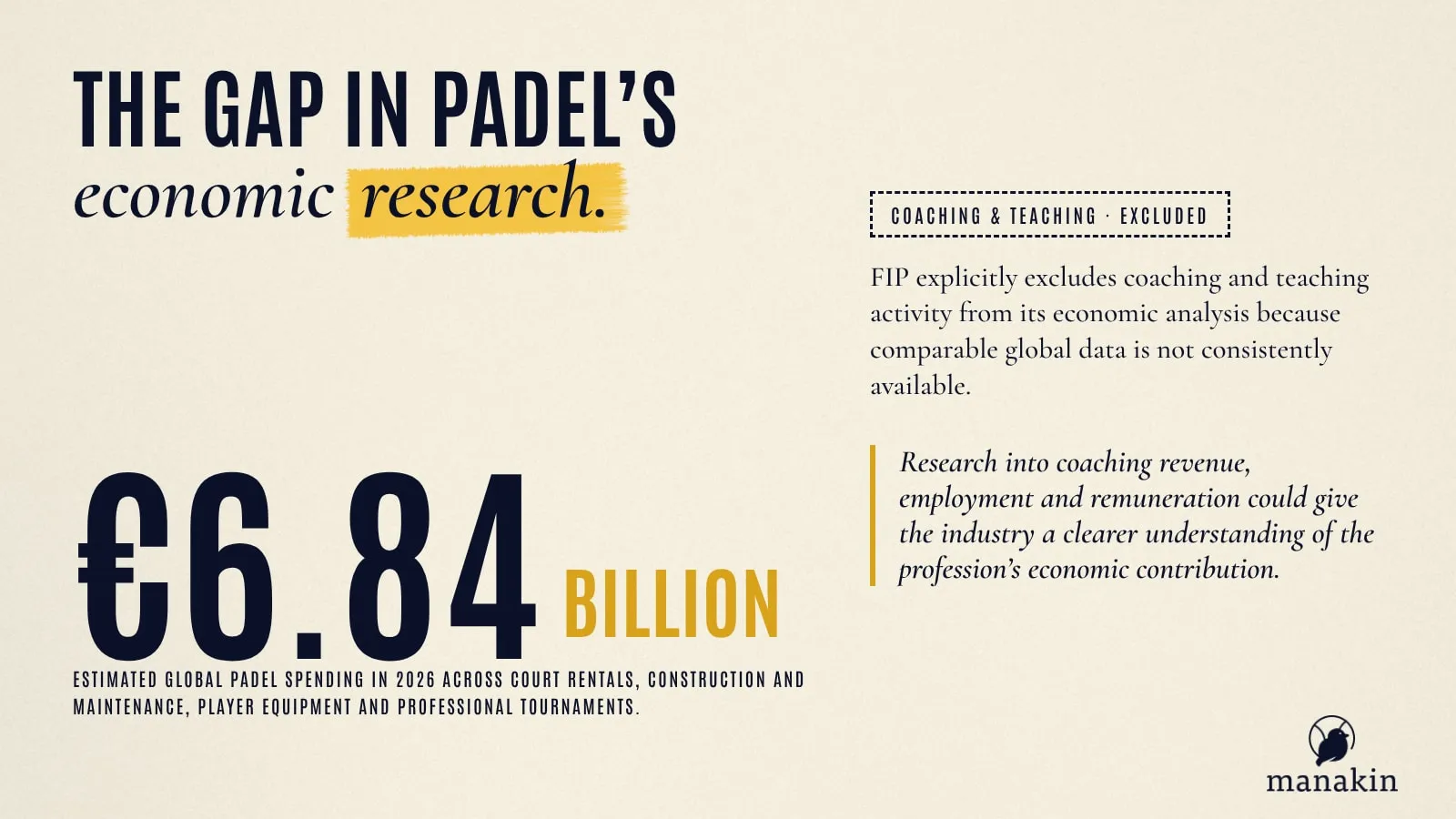
FIP estimates €6.84 billion in global padel spending in 2026, excluding coaching and teaching due to limited comparable data.
Coaching and teaching are excluded from this expenditure analysis because consistently comparable global data is not available. That does not imply coaching has no economic contribution; it means this specific estimate does not quantify it. Without stronger data on coaching revenue, employment and remuneration, the industry cannot confidently describe the profession’s economic scale.
6. Better data, better-informed decisions
The report’s first coaching licence survey marks progress, while the economic analysis exposes an important research gap. Court expansion can indicate where to investigate, qualifications can inform professional development, and language requirements can influence eligibility, but none of these alone offers a complete picture of career sustainability.
More comprehensive data could help coaches assess international opportunities, employers plan recruitment, and federations evaluate workforce development. The next question is not only where padel is growing, but how the coaching profession is developing alongside it.
The need for better data on padel coaching employment, qualifications, and economic contribution to support career decisions and industry growth.
Turn industry insight into your next move
For coaches: Understanding a market is the first step. Browse padel coaching vacancies on Manakin, compare language and qualification requirements, and find a role that matches your experience.
Explore padel coach jobs on Manakin.
For clubs and academies: Court growth alone does not build a coaching team. Reach professionals actively exploring padel careers by publishing your next vacancy on Manakin, with clear requirements that help suitable candidates assess the opportunity.
Post a coaching vacancy on Manakin.
Editorial note: Figures from the FIP World Padel Report 2026 are distinguished from external market examples, coaching programme announcements, and Manakin recruitment listings. Career implications are editorial analysis, not employment forecasts.